By Federica Lassi Photos by Federica Lassi with the contribution of Roberto Pozzi
Table of Contents
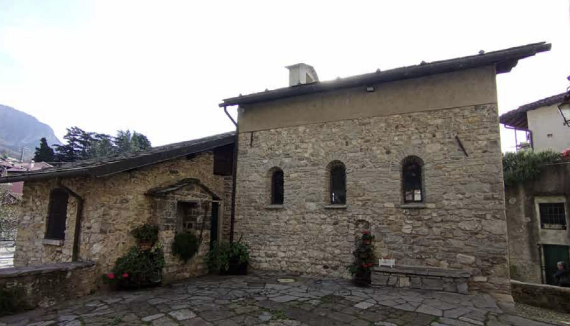
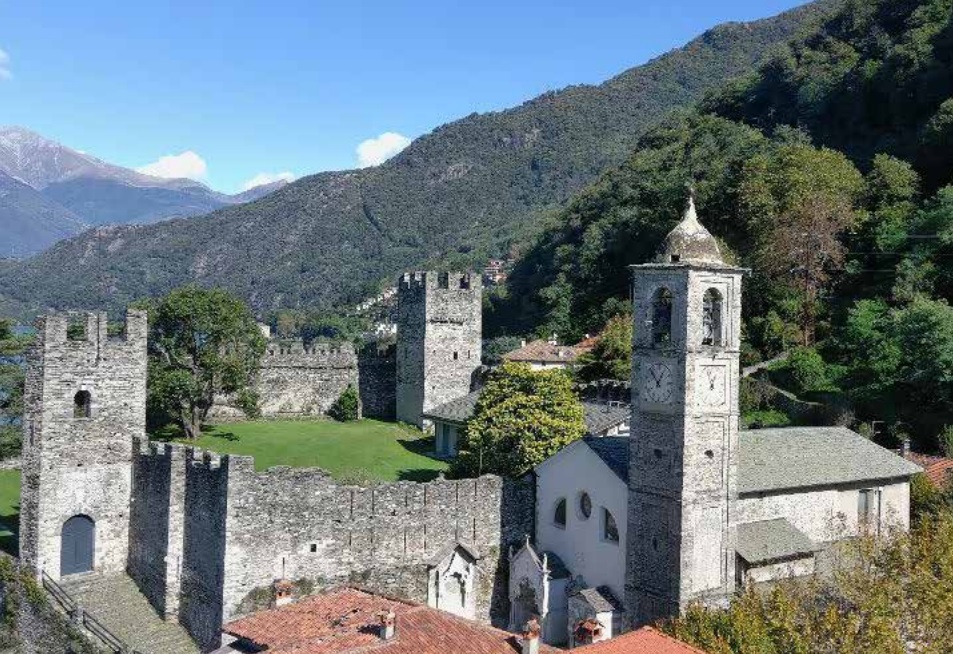
In the hamlet of Lierna Castle, amongst stone houses and narrow passageways that still retain the form of the ancient medieval core, the small church of Saints Maurice and Lazarus represents one of the most solid historical landmarks of the area. It does not possess the size or monumentality of other sacred buildings on the lake, but its presence is constant and deeply rooted: for almost nine centuries it has accompanied the evolution of the local community and reflects, on a small scale, events that also concern the wider history of Northern Italy.
The first record of the little church dates back to 1147, when it was recorded as belonging to the Milanese monastery of San Dionigi. At the time, it was dedicated exclusively to Saint Maurice, a warrior saint and protector of fortified places: a choice consistent with the defensive function of Lierna Castle, a strategic point on the eastern branch of Lake Como.
The subsequent addition of the title of Saint Lazarus was not a mere devotional detail, but the effect of cultural ties that, over the centuries, also linked peripheral realities like Lierna to the history of the Order of Saints Maurice and Lazarus. A chivalric order whose story spans centuries, intertwining with the Savoy dynasty, with the cult of the martyr Maurice of Agaunum, and even with the coining of Mauritian coins as early as the 12th century. Within this broad context, the small Lierna church is a local but significant testament, capable of reflecting contacts, influences, and devotions that extended beyond the village borders.
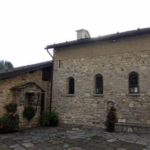
Looking at it today, the little church retains a sobriety that is not poverty, but authenticity. The rough stone of the original building, the layered restorations over the centuries, the simple oculus above the portal: every element betrays a history of continuous use, adaptation, and essential care. The apse, facing the lake, was once protected by a bastion. Here, the dual role of the building can be perceived: a place of worship, but also a potential refuge during sieges. Access, in fact, was from within the village walls, so that the community could attend services even in the most difficult times. On the facade, the figures of Saints Maurice and Lazarus still stand: warriors, as the iconographic tradition dictates. Probably Baroque frescoes, perhaps repainted over older images, fragments of a painted narrative that has lost its clarity over the centuries but not its meaning.
The documentation between the 16th and 18th centuries paints a clear picture: the small church was often in a precarious state. Dampness, damaged floors, ruined roofs, minimal furnishings. In 1567, Bishop Volpi ordered urgent repairs, even severely admonishing the faithful. In 1593, Bishop Ninguarda described the building again, confirming that the frescoes were already considered very old at that time. During the restorations in the 1930s, remains of internal frescoes (including figures of Stefano and Sebastiano) re-emerged, and, crucially, tombs and bones located both nearby and within the walls themselves. This discovery is consistent with sources indicating the presence of a cemetery around the small church during the plague centuries.
The history of the building is not just made of stone and relics, but of relationships. In 1375, right here, an agreement of vassalage was signed between Lierna and Varenna. Over the centuries, the two centres long vied for ecclesiastical jurisdiction over the chapel, arguing over who had the right to celebrate Mass and funerals there. And then again: in the 17th and 18th centuries, various endowments, such as those from the Campioni family, guaranteed the celebration of annual Masses on certain days of the year, while small plots of land were allocated to the church to support its maintenance. In the 18th century, the priest responsible for religious assistance, Don Carlo Antonio Brentani, also resided at the Castle. And among the most significant testaments is that of Pietro Paolo Panizza, whose family is still traditionally linked to the custody of the chapel: a genealogical thread spanning centuries of silent dedication.
Every year, the relic of St Maurice kept in the little church is carried in procession along the Riva Bianca: a simple gesture but one that links the present to a tradition that has lasted for centuries. Today, the small church of St Maurice and St Lazarus is not only a monument of the past: it is a point of continuity. Its small size, its essential façade and its position within the historic core contribute to maintaining a balanced relationship with its surroundings. Those who arrive there do not find a building designed to impress, but a place that speaks above all through its documented history, its transformations and its constant relationship with the community. A discreet but significant presence that continues to define the village's identity without the need for grand gestures, simply remaining what it has always been: a small church capable of crossing the centuries together with Lierna.
This site uses cookies to manage navigation, content customisation, traffic analysis. By closing the banner you consent to the use of technical cookies only. This choice can be changed at any time.
When you visit a website, information may be stored or retrieved and saved in the cache of your browser, mainly in the form of cookies. Check your cookie services here.
These tracking tools are strictly necessary to ensure the operation and provision of the service you have requested from us and, therefore, do not require your consent.
These cookies are set by Google's recaptcha service to identify bots to protect the website from malicious spam attacks and to test whether the browser is able to receive cookies.
wordpress_test_cookie
wp_lang
These tracking tools enable simple interactions and functionalities that allow you to access certain resources of our service and make it easier for you to communicate with us.
Cookies necessary for the proper functioning of the website and performance. Some cookies are associated with Google Universal Analytics, which is a significant upgrade of Google's most commonly used analysis service.
These tracking tools allow us to provide you with commercial content personalised according to your behaviour and to manage, deliver and track advertisements.