by Federica Lassi Photos of Federica Lassi and Alberto Locatelli
Table of Contents
Ask the A.I. assistant.
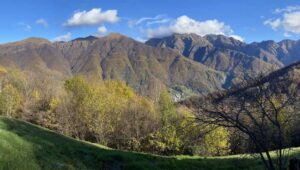
“At the annual celebration of your feast day, we wish to renew the ancestral devotion of our forefathers who dedicated this beautiful little church to you, nestled on the hill, surrounded by woods and overlooking the lake.”.
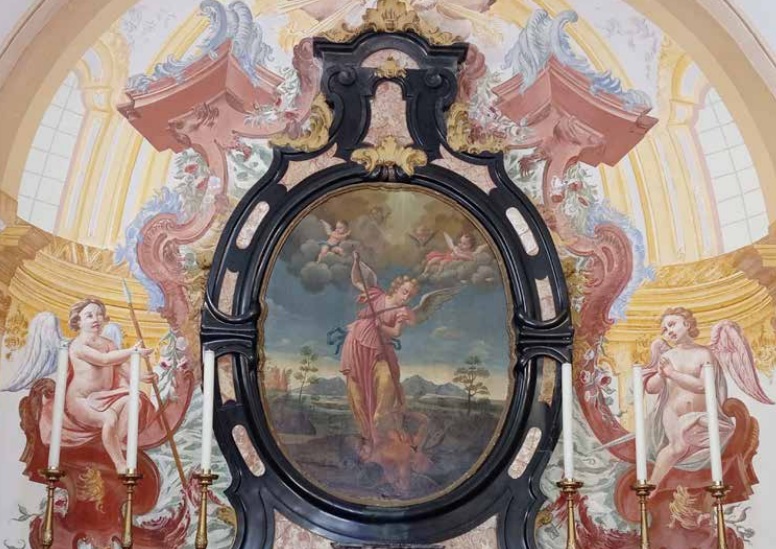
It is not a description of Paradise that emerges from the words of Don Marco Malugani, parish priest of Lierna, used in the opening of the invocation to Saint Michael the Archangel written in September 2021, but of the landscape that surrounds the Oratory of Saint Michael in Lierna, a jewel that can be found along the Sentiero del Viandante (Walker's Path), shortly before venturing into the cobbled alleys of Sornico, a hamlet where time seems to have stood still. Likely of Lombard origin, it was rebuilt in the early 17th century, as reported on the sign placed along the stone wall bordering the path. The little church is made of grey stone, but its facade is a beautiful yellow, over which stands a small fresco from 1926 depicting Saint Michael the Archangel himself. Passing through the entrance door, the altar stands out opposite, in polychrome marble with mother-of-pearl inlays, topped by a late 18th-century fresco, featuring angels and floral decorations. They depict Saint Michael surrounded by the lake and mountains, a reference to the territory surrounding the Oratory. On either side of the altar are two large oil paintings, depicting Saint Anthony and Saint Louis of Toulouse. Among the valuable elements found inside are a carved stone font for holy water, a small wooden Way of the Cross hanging on the walls, and a red marble washbasin, the latter located in the sacristy, which was built after the church itself. These are fundamental historical notes for understanding the origins and development of the Oratory of San Michele, although to grasp its soul, rather than relying on a sterile panel, one must speak with the inhabitants of Sornico. With proud local pride, they recount how each church in Lierna is linked to a Saint and a festival dedicated to him, and how these celebrations they generated (and continue to generate) a sort of “rivalry” between the factions.
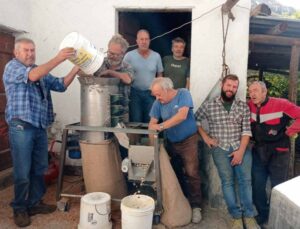
Although Holy Masses and processions at the Oratory of San Michele began, with the passage of time, to thin out, the traditional feast in honour of the saint after whom it is named, the Feast of San Michele, which falls every 29 September regardless of whether it is a weekday or a public holiday, remains firmly established to this day, to bring together under a single bell-tower hamlets of Sornico, visitors and travellers from distant lands, even from the New World, Argentina or Uruguay, who have been struck by the beauty of Lierna, Sornico and its little church, places of origin of their ancestors. For the occasion, the entire hamlet is decked out and festively illuminated by the anxious hamlet residents who are eagerly awaiting to experience it and show their devotion to the Saint. Days marked by religiousness, but also folklore among mulled wine, polenta, chestnuts, traditional songs, the enchantment of the baskets and much more to carry on the upkeep of the church. Tradition to be preserved, but also to be renewed by reviving the games of yesteryear such as the pentolaccia, the sack and donkey race, and the cuccagna. This is what the organisers of the Feast of St Michael hope for in the future, to keep the Oratory alive and bring new generations together, so as to keep its soul vibrant in the years and centuries to come. So, not only to make St Michael's Oratory shine through the Sentiero del Viandante (Wayfarer's Path) next to it, which has gained significant popularity and is walked every day by a considerable number of people, all potential visitors to the little church, but to follow in parallel what Don Marco said in the concluding paragraph of the invocation to St Michael, to ensure that the building is never left to itself and that nothing more remains of it than historical notions on a panel: “We shall strive generously to preserve the decorum of this holy temple, so that in it God may be praised, the Virgin Mary invoked, our dead remembered and You, Prince of the Heavenly Militia, worthily venerated. Amen”.
This site uses cookies to manage navigation, content customisation, traffic analysis. By closing the banner you consent to the use of technical cookies only. This choice can be changed at any time.
When you visit a website, information may be stored or retrieved and saved in the cache of your browser, mainly in the form of cookies. Check your cookie services here.
These tracking tools are strictly necessary to ensure the operation and provision of the service you have requested from us and, therefore, do not require your consent.
These cookies are set by Google's recaptcha service to identify bots to protect the website from malicious spam attacks and to test whether the browser is able to receive cookies.
wordpress_test_cookie
wp_lang
These tracking tools enable simple interactions and functionalities that allow you to access certain resources of our service and make it easier for you to communicate with us.
Cookies necessary for the proper functioning of the website and performance. Some cookies are associated with Google Universal Analytics, which is a significant upgrade of Google's most commonly used analysis service.
These tracking tools allow us to provide you with commercial content personalised according to your behaviour and to manage, deliver and track advertisements.