by Caterina Franci Credit: Domenico Arrigoni archive photo
Table of Contents
Ask the A.I. assistant.
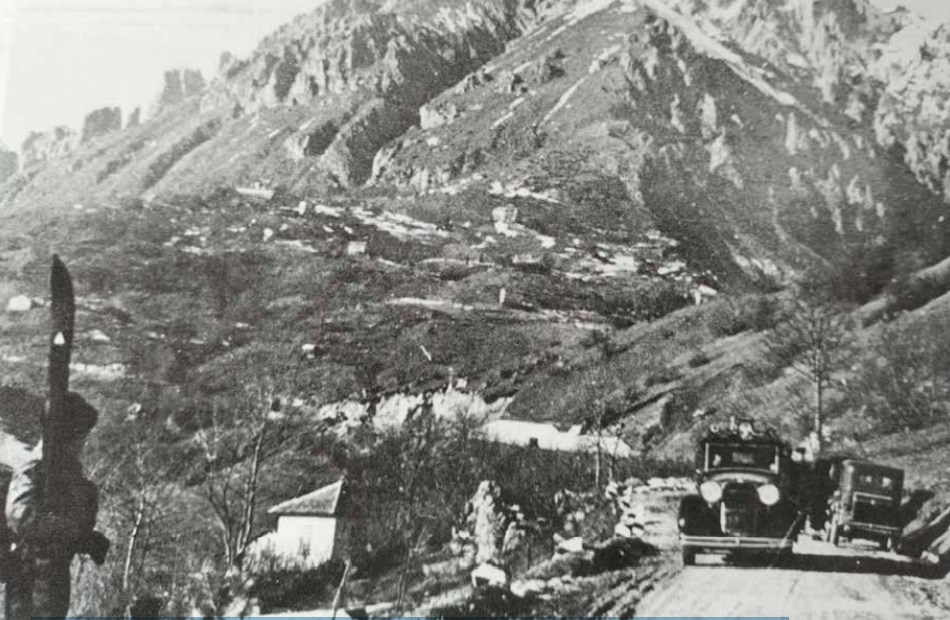
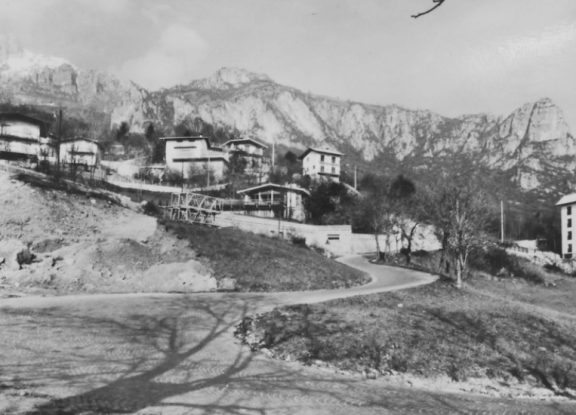
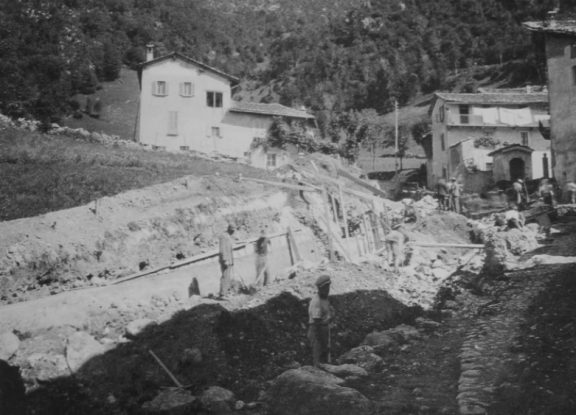
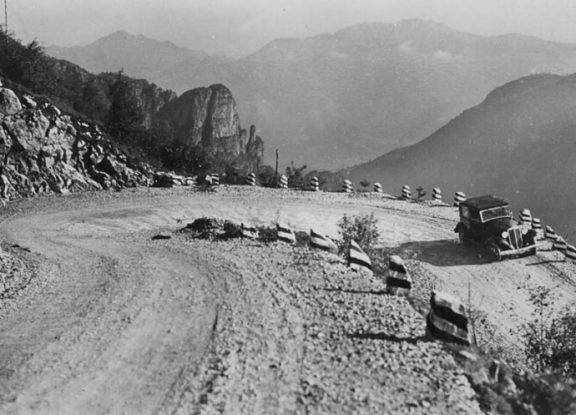
The road from Ballabio up to Piani Resinelli is the only carriageable access road and has a history closely intertwined with the economic, social and landscape development of the area. The Piani Resinelli began to be known from a tourist point of view at the beginning of the 20th century, but until a century earlier they were mainly used during the summer months as alpine pastures. In the winter season, however, the locality remained practically isolated, until mountaineering interest gave the impetus for the construction of several mountain huts, among which, in 1908 the Capanna Escursionisti Lecchesi (today SEL) and in 1910 the Rifugio Carlo Porta. The locality thus experienced an important development, including tourism, with the gradual construction of prestigious villas and residences. Circumstances that contributed to starting to think about a suitable carriage road to reach the locality. It was 1931, and on 18 December, engineer Bernardo Sironi wrote a letter to the mayor of Ballabio, Cav. Uff. Luigi Locatelli. “A large group of people – the letter reads – encouraged by the prompt and fervent cordial interest of the Honourable Mayors of Lecco, Abbadia Lariana, Mandello, and Ballabio, considering how useful the construction of the carriageable road from Ballabio to Piani Resinelli would be for the development of that magnificent alpine area, and at this particular moment, as one of the works suitable to help alleviate unemployment, has instructed the undersigned to initiate a meeting, to be held at the Lecco Town Hall on 31 December at 3 p.m., for the purpose of discussing and formalising the financing method for the project and obtaining the necessary support from Public Bodies and Private Individuals”. In 1933, the Mayor decreed with a specific resolution to join the Consortium of 4 municipalities (Lecco, Abbadia, Mandello, and Ballabio) for the construction and maintenance of the road leading at the Piani Resinelli and its connection to the road network of the Municipality of Ballabio. The work, described as “bold,” was designed by engineer Sironi. Construction began in June 1934, and within two years – approximately 10,000 working days – the road was built by the Pietro Gerosa Crotta company: 14 hairpin bends, 8.950 km in length and a gradient of 7, maximum 9%, to cover an altitude difference of over 600 metres, from 600 metres in Ballabio to 1,200 of the Resinelli Plans.
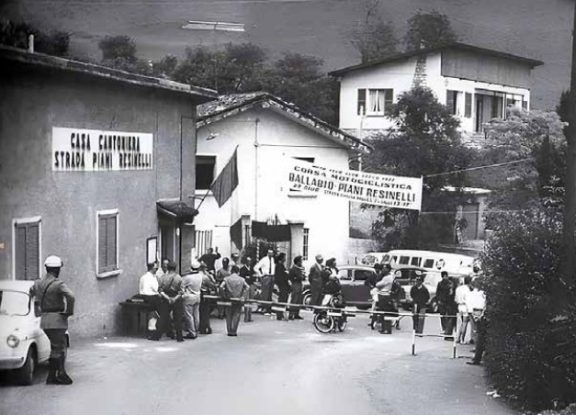
“For a good two years,” reads an article of the time by Augusto De Micheli, “the work gave a lot of work to the people of Ballabio and again after the war, when the paving was resurfaced (from beaten earth to asphalt) and then the hairpin bends were better arranged. One of the most difficult questions to resolve was how to finance the work, which cost 1.3 million lire. A figure that was mostly asked of private individuals who had homes at the Resinelli, due to the increase in the value of their properties as a result of the road link, with an additional contribution from the four municipalities of the Consortium, divided as follows: 60,000 lire Lecco, 30,000 lire Abbadia Lariana, 25,000 lire Mandello and 25,000 lire Ballabio. Curiosities relating to the financing of the work include a letter dated 15 May 1939 from the Royal Prefecture of Como addressed to the Podestà of Ballabio, pointing out that two loan repayment instalments already advanced by the Municipality of Lecco but not yet repaid were due. On the other hand, it dates back to 1942 when the Prefectural Commissioner of Ballabio, Pietro Angelo Donghi, approved the negotiation at the Cassa di Risparmio delle Province Lombarde of a loan of 74,562 lire to pay the Consortium the balance of the instalment spent on the construction of the road. ‘The heavy burden of the financial commitment (not foreseen),’ De Micheli's article goes on to say, ”was due to the fact of the ’...very strong decrease in tolls due to the limitation in the use of motor vehicles in the current wartime contingency‘’. Once the conflict ended in 1945, the Piani Resinelli became a popular and popular destination for people from the plains who could spend holiday periods or Sunday outings here. From the post-war period until around the end of the 1970s, the 'stanga' for access to the road, for which a toll was paid, was positioned near the Casa Cantoniera in Ballabio Superiore. Along the hairpin bends, from 1961 onwards, the historic Ballabio-Piani Resinelli hill-climb was also held, a motorbike race organised by the Moto Velo Club Lecco. And it is precisely thanks to that road that the Piani Resinelli today remains a popular destination not only for hikers, but even by cyclists and motorcyclists, confirming the soundness of that intuition from almost 100 years ago.
This site uses cookies to manage navigation, content customisation, traffic analysis. By closing the banner you consent to the use of technical cookies only. This choice can be changed at any time.
When you visit a website, information may be stored or retrieved and saved in the cache of your browser, mainly in the form of cookies. Check your cookie services here.
These tracking tools are strictly necessary to ensure the operation and provision of the service you have requested from us and, therefore, do not require your consent.
These cookies are set by Google's recaptcha service to identify bots to protect the website from malicious spam attacks and to test whether the browser is able to receive cookies.
wordpress_test_cookie
wp_lang
These tracking tools enable simple interactions and functionalities that allow you to access certain resources of our service and make it easier for you to communicate with us.
Cookies necessary for the proper functioning of the website and performance. Some cookies are associated with Google Universal Analytics, which is a significant upgrade of Google's most commonly used analysis service.
These tracking tools allow us to provide you with commercial content personalised according to your behaviour and to manage, deliver and track advertisements.